
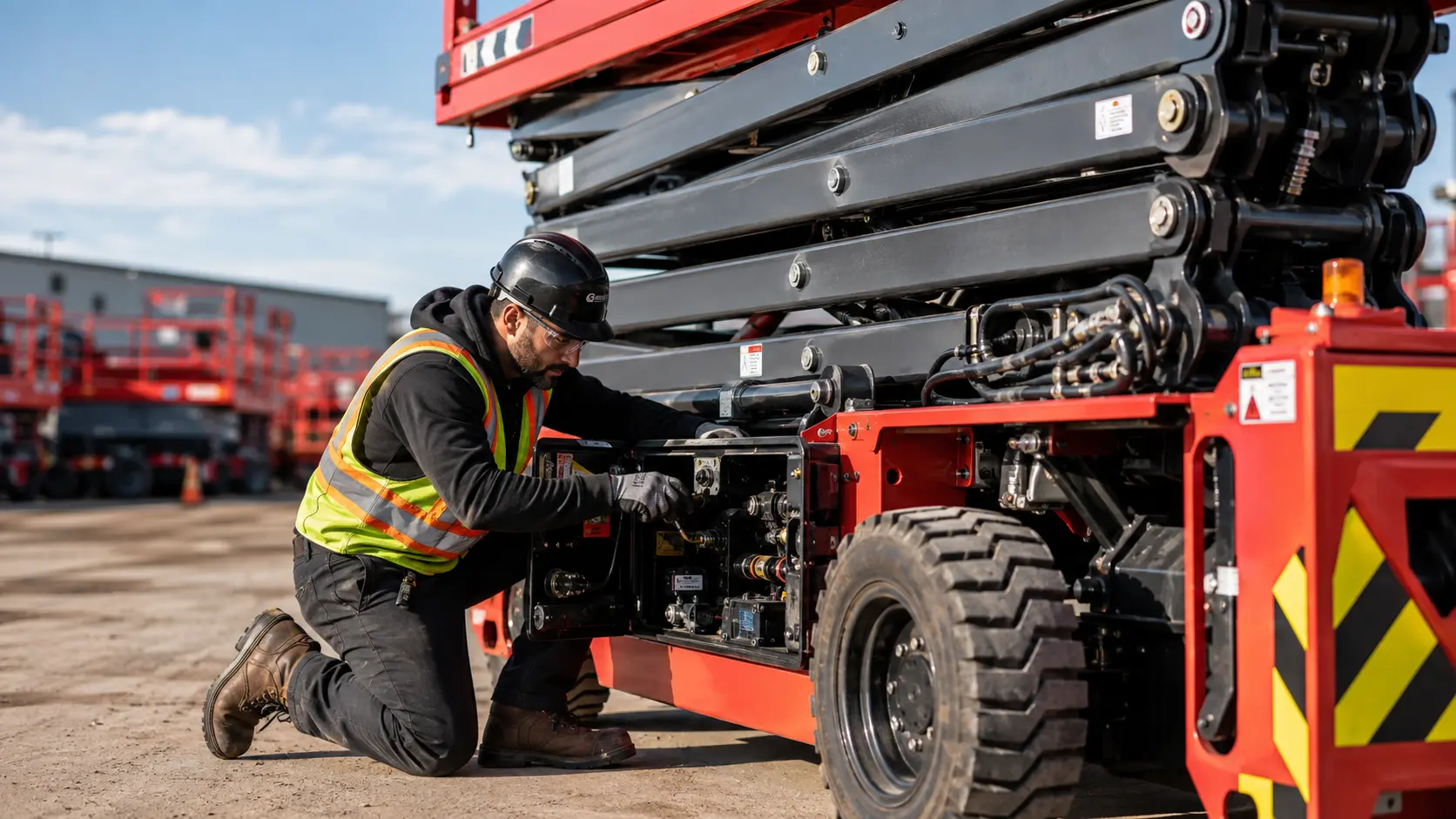
Purchasing pre-owned aerial work platforms requires rigorous mechanical due diligence. Whether you are acquiring an electric scissor lift, an articulating boom, a vertical mast man lift, or a heavy telescopic telehandler, conducting a hands-on physical inspection protects your investment and ensures your workforce operates in compliance with safety standards.
1. Structural & Chassis Inspection
Begin by thoroughly examining the machine's primary structural framework on level ground:
- Scissor Stack & Boom Welds: Inspect all factory weld seams for stress fractures, rust blistering, or non-factory repair welds. Verify that scissor arms are parallel and free from twisting or bending.
- Pivot Pins & Bushings: Check for excessive play at all scissor hinge points and boom pivot pins. Excess tolerance leads to platform instability at maximum working height.
- Tires & Wheels: On indoor slab lifts, inspect solid non-marking rubber tires for chunking, flat spots, or chemical deterioration. On rough terrain machines, check foam-filled tire tread depth and wheel lug nut torque.
- Pothole Protection Bars: On slab scissor lifts, verify that mechanical pothole protection bars deploy automatically when the platform is raised and retract smoothly when lowered.
2. Hydraulic System & Fluid Analysis
The hydraulic system is the powerhouse of any aerial work platform:
- Cylinder Rods & Wiper Seals: Inspect all hydraulic lift, steer, and extension cylinders. Chrome rods must be mirror-smooth, free of pitting, rust, or deep gouges that could damage wiper seals.
- Hose Integrity & Routing: Look for hydraulic hose blistering, cracking, oil weeping at crimped fittings, or rub wear along internal hose carriers.
- Valve Manifold: Check the hydraulic control manifold for external fluid seepage around proportional solenoid valves.
- Hydraulic Drift Test: Elevate the platform to full working height with rated test weight and leave it stationary for 15 minutes. Any noticeable downward drift indicates internal cylinder seal bypassing or check valve failure.
3. Electrical Components & Battery Health
On electric machines, the battery bank represents a critical operational cost:
- Battery Pack Date Code & Voltage: Check date stamp codes on battery cases. Test individual cell voltages under load to identify failing cells.
- Terminal Posts & Cables: Verify that battery terminals are clean, securely torqued, and free of heavy lead-acid sulfate corrosion.
- Integrated Onboard Charger: Plug the machine into a 120V AC circuit to confirm that the onboard smart charger cycles properly and displays correct charging phase LED indicators.
4. Controls, Safety Devices & Emergency Lowering
Test all dual control stations (ground console and platform control box):
- Proportional Joystick Operation: Confirm smooth, progressive speed modulation without jerky starts or unexpected stalling.
- Emergency Lowering System: With the main battery disconnect engaged or machine powered down, test manual emergency lowering valves and auxiliary power units to ensure reliable descent.
- Tilt Sensor & Motion Alarms: Drive the machine onto a slight test slope to verify that the tilt sensor alarm triggers and cuts out lift functions per safety design.
- Platform Gate & Lanyard Anchor Points: Verify that the self-closing entry gate latches securely and certified fall arrest anchor points are clearly stamped and undamaged.
5. Compliance Records & Documentation
Ensure the equipment includes required legal documentation, including manufacturer operator manuals, equipment logbooks, and certified annual inspection records. For detailed regional safety standards, read our guide on Ontario aerial lift inspection requirements.